



1- Beyond Production: How Is Economic Resilience Built Across the Steel Value Chain?
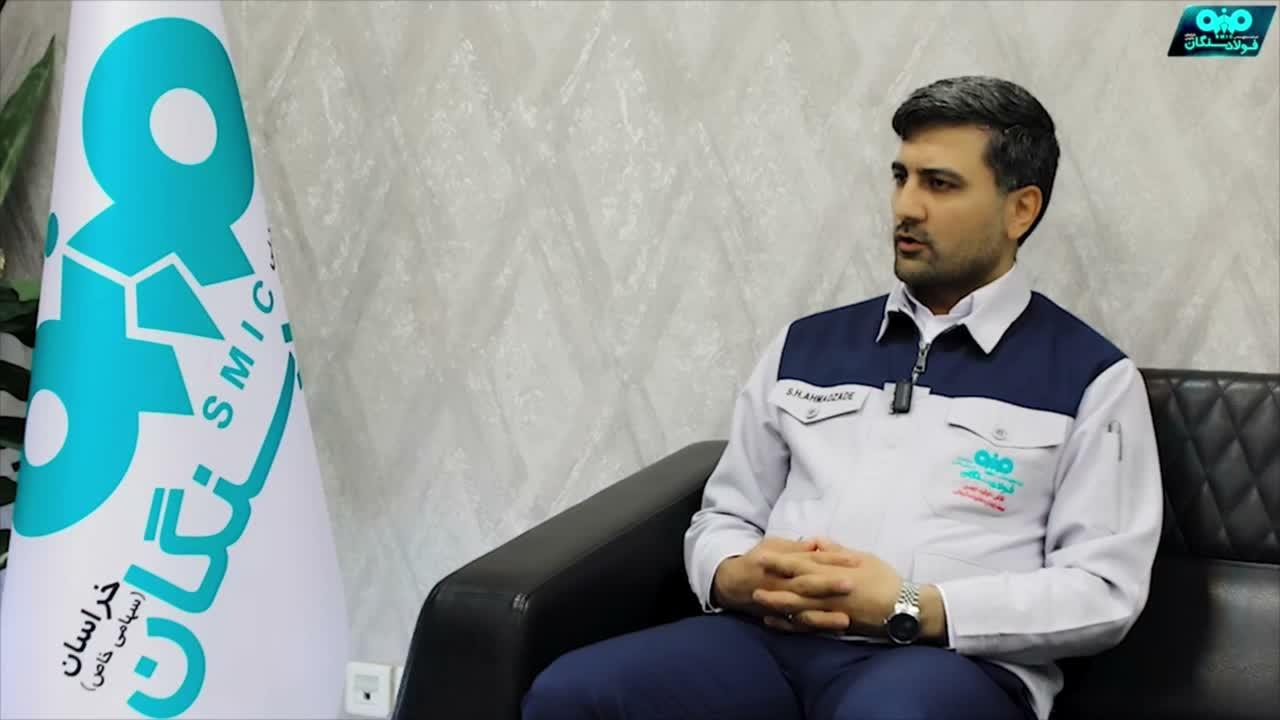
Seyed Hossein Ahmadzadeh, Deputy for Finance and Economics at Sangan steel
The second half of the year presents upstream steel producers with external variables, unstable feedstock supply, changing buyer behaviour, and price volatility. In such an environment, a company’s profitability is not determined solely by higher production or stronger selling prices. It also depends on its ability to manage risk, control production costs, maintain cash flow, diversify markets, and use capital and production capacity efficiently. Sangan steel company has pursued a range of financial, economic, and commercial measures to maintain production continuity and financial stability.
Ahmadzadeh said that when external variables change rapidly, profitability cannot be explained by production volume and selling price alone. For a capital-intensive industrial company, the central challenge is to maintain production, liquidity, economic margins, and returns on investment simultaneously. The company’s decisions therefore focus on risk management, cost control, operational continuity, and balance among revenue, expenditure, and cash flow.
From a corporate-economics perspective, each decision must take account of the opportunity cost of resources. If part of production capacity remains idle because of feedstock shortages or market disruption, the company loses not only potential revenue but also the expected return on the capital invested in that capacity. Maintaining operations and reducing downtime are therefore financial and economic priorities in their own right.
Concentration on a single customer or market increases a company’s financial risk. Maintaining a strategic relationship with Mobarakeh Steel remains important to Sangan steel; at the same time, the company has sought to diversify sales destinations and make greater use of the commodity exchange and new domestic and foreign markets. From a risk-management perspective, market diversification reduces customer-concentration risk and makes revenue flows more flexible. When one market segment is in recession, alternative markets can help convert inventory into cash more quickly and reduce pressure on working capital.
Ahmadzadeh said cooperation with certain companies to convert pellets into direct reduced iron could be analysed as a way of optimizing the value chain. When part of the pellet output is converted into DRI and then supplied to Mobarakeh Steel’s reduction and rolling lines, existing capacity across the chain can be used more effectively. In industrial cost accounting, the economic value of a product is not limited to its selling price at one stage. Conversion, transport, energy, inventory, and working-capital opportunity costs must all be considered to identify the most economical route. The objective is to increase value across the entire chain, rather than simply increase sales at one link.
Feedstock is a decisive variable in the economics of production. When iron ore supply is unstable, concentrate and pellet production are affected, and fixed costs per unit of output rise. Since some plant costs remain fixed in the short term, lower production increases the fixed-cost share of each tonne produced. Feedstock stability is therefore not merely a production issue; it directly affects unit costs, profit margins, and return on capital.
One of Sangan steel’s responses has been to diversify feedstock sources. Purchasing concentrate through commercial channels and procuring alluvial iron ore when required have helped prevent interruptions to the pelletizing plant’s feed. Economically, this is a form of operational insurance against supply risk. Each alternative source must nevertheless be assessed carefully in terms of total cost, transport, feed quality, energy consumption, and process recovery. The objective is not simply to purchase more feed, but to secure it economically and maintain stable production.
Regarding situations in which product prices fall below production costs, Ahmadzadeh said fixed and variable costs must be distinguished and the decision horizon carefully assessed. In the short term, continuing production may in some circumstances be more economical than a complete shutdown if revenue covers variable costs and part of fixed costs. Such decisions, however, must be based on accurate case-specific information. In the long term, no industrial company can continue indefinitely when production is structurally uneconomic. The response must therefore combine lower unit costs, higher productivity, a better market mix, and careful management of prices and contracts.
In an inflationary environment, cost management does not mean indiscriminate spending cuts. It means distinguishing value-creating costs from those that do not generate economic value and allocating resources to activities with the highest returns. For Sangan steel, improving equipment productivity, reducing downtime, managing energy consumption, optimizing feedstock procurement, and lowering logistics costs can all directly affect the cost per tonne. Even a modest productivity improvement can have a substantial financial impact when applied across millions of tonnes of capacity.
Ahmadzadeh added that organized trading on the Iran Mercantile Exchange can provide a more transparent transaction mechanism, support market management, and reduce sales risk. For an industrial company, the speed at which products are converted into cash and the predictability of cash flows are crucial. Shorter and more controllable intervals between production, sale, and collection reduce the need for external financing and help manage financing costs. Sales policy is therefore part of the company’s financial-management architecture.
Infrastructure self-sufficiency should also be evaluated by comparing initial investment with long-term benefits. If an infrastructure project reduces the risk of shutdown, lowers operating costs, or improves production reliability, the present value of its future benefits should be assessed alongside its capital cost. At Sangan steel, such decisions should take account of asset life cycles, rates of return, and the opportunity cost of resources. A costly project is not necessarily uneconomic, just as building infrastructure does not automatically make a project economically justified. The decisive criterion is the economic value created over the project’s lifetime.
Ahmadzadeh concluded that the company’s path forward rests on several priorities: maintaining production continuity, diversifying markets and supply sources, controlling unit costs, improving productivity, and managing working capital intelligently. Financial management is no longer merely the recording and reporting of transactions; it is part of industrial decision-making. Financial information should help management determine where to invest, where to reduce costs, which markets to develop, and how to control the risk of production interruptions or declines. The ultimate goal is not simply to weather temporary market volatility, but to establish a resilient economic model capable of sustaining Sangan steel’s operations and long-term value creation amid shocks to prices, feedstock, energy, and markets.