


1- A Strategic Shift in Eastern Iran: When Production Becomes a Platform for Development
In recent years, Sangan steel company has moved towards simultaneous investment in production, energy, water, logistics, infrastructure, and complementary industries. This raises an important question: is the company’s mission still limited to increasing production capacity, or is it assuming a broader role as one of the drivers behind the emergence of an industrial hub in eastern Iran?
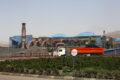
Sangan steel company is no longer simply a concentrate and pellet producer—at least, that is the picture suggested by its development-project portfolio. Operating with nominal capacities of 5 million tonnes of concentrate and 5 million tonnes of pellets, the company is simultaneously pursuing capacity expansion, processing of hematite ore, water supply from municipal wastewater, construction of a wind farm, transport development, direct involvement in mining, and new infrastructure. Production remains at the core of its business model, while development and infrastructure projects are being pursued over a one- to two-year horizon. These projects cover capacity, product quality, water, energy, automation, loading, and infrastructure.
The significance of the development plan lies in the gradual move beyond a factory-centred perspective. When a mining company invests not only in production capacity but also in water supply, power generation, transport networks, new processing facilities, tailings management, and regional infrastructure, its contribution to the regional economy is no longer measured solely by factory output. Sangan steel company is developing a network of infrastructure that could influence the industrial capacity of the Sangan district and eastern Iran.
Key projects illustrating this shift include a 200 MW wind farm, a hematite concentrate plant with a capacity of 2.5 million tonnes, mechanized tailings stacking, water-transfer projects, and the construction of the Taybad wastewater treatment plant. These projects form part of a long-term initiative referred to as the Eastern Industrial Development Belt. They are particularly significant because some of the main constraints on industrial development in eastern Iran are precisely in energy, water, and transport infrastructure. Sangan steel company is therefore investing not only in higher factory output, but also in infrastructure that is a prerequisite for sustainable industrial activity in the region.
If capacity expansion results only in higher output of a single mineral product, its impact on the regional economy will remain limited. If, however, production growth is accompanied by downstream industries, engineering services, transport, specialist maintenance, technical know-how, and related businesses, the economic value created in the region will be more enduring. Employment should consequently expand beyond direct factory jobs to encompass an industrial employment ecosystem involving contractors, transport operators, technical-service providers, parts suppliers, knowledge-based companies, and downstream industries.
The future of Sangan can be framed around one question: can the district become a place where mining, energy, water, transport, processing, downstream industries, and industrial employment are connected? The development projects underway at Sangan steel company point in this direction, although realizing a fully developed industrial hub will depend on completing infrastructure projects and establishing complementary industries and businesses around the complex.
It may therefore be more accurate to describe Sangan steel’s future not as a transition away from steel production towards an industrial hub, but as the use of steel production as a platform for creating an industrial hub in eastern Iran. This is where the impact of a mining company can extend beyond the factory and become part of a region’s industrial-development architecture. Today, production and regional development are increasingly interconnected at Sangan steel. Concentrate and pellet capacity remain the company’s main pillars, but investments in renewable energy, water, logistics, mineral processing, and regional infrastructure have broadened its role.